
Last Updated 05/04/2026 published 05/04/2026 by Hans Smedema
Page Content
Admissibility Analysis: Smedema v. The Kingdom of the Netherlands (Communication under Art. 22 CAT)
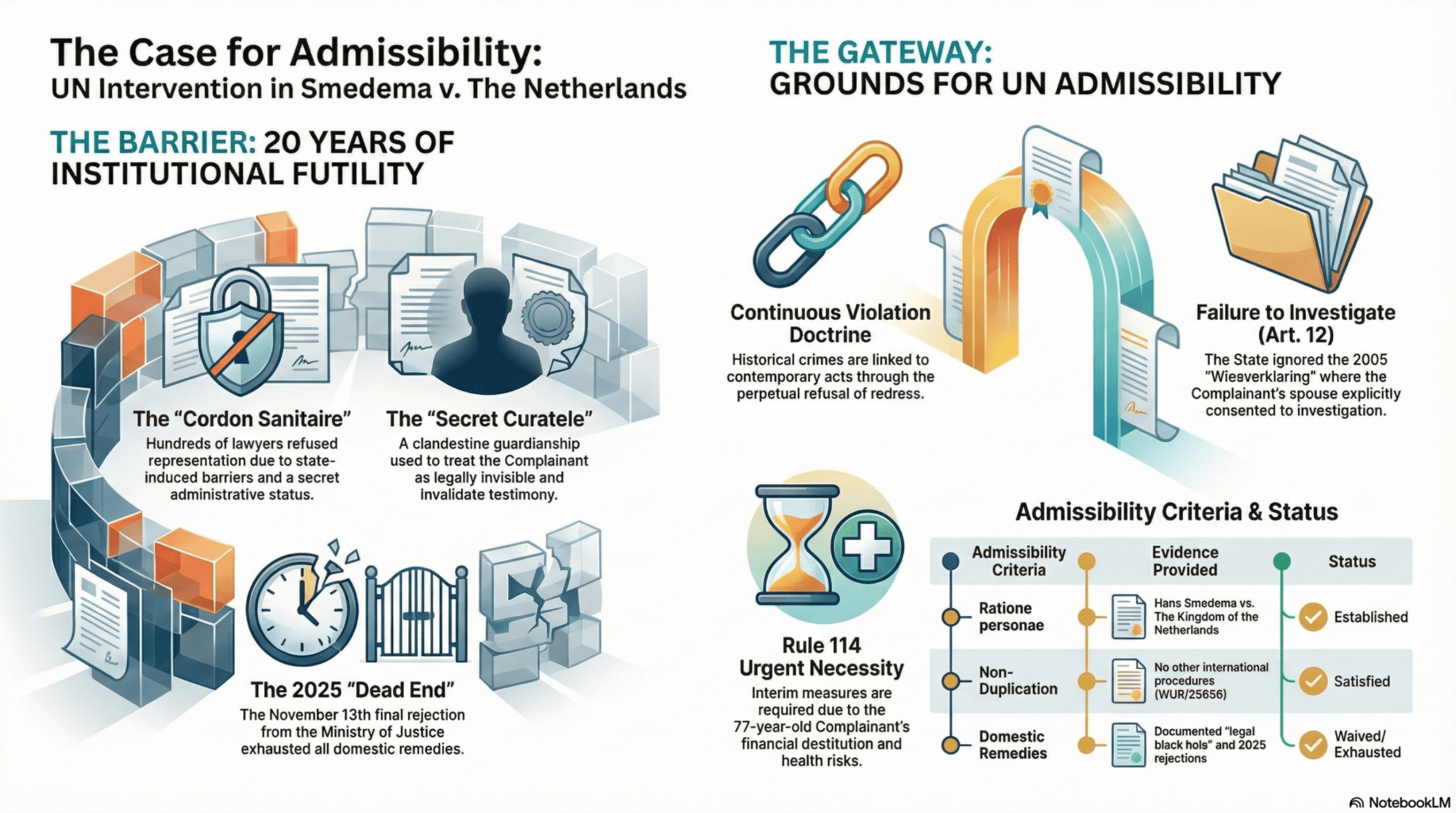
1. Formal Admissibility and Jurisdictional Competence
Establishing a prima facie case for admissibility is the essential strategic gateway for any communication before the Committee Against Torture (CAT). Under the procedural requirements of Article 22 of the Convention, the Committee cannot engage with the substantive merits of a claim—regardless of the severity of the alleged torture—unless the Complainant demonstrates that all jurisdictional and procedural thresholds have been met. Without satisfying these requirements, the State Party’s jus cogens obligations regarding torture cannot be adjudicated. In the matter of Hans Smedema, the threshold is met by demonstrating that the State Party is both the direct architect of and the ongoing obstacle to redress.
Procedural Status Assessment
| Criteria | Source Evidence | Convention Article | Admissibility Impact |
| Jurisdiction (Ratione personae) | Hans Smedema (Complainant) vs. The Kingdom of the Netherlands. | Article 22 | Established. Direct victim standing. |
| Jurisdiction (Ratione loci) | Acts within Dutch territory (Zeist, Utrecht, Drachten, Schiphol). | Article 2(1) | Established. State Party responsibility. |
| Non-Duplication | WUR/25656; no other international procedures pending. | Article 22(5)(a) | Satisfied. No bar to Committee review. |
| Victim Standing | Identified as direct victim of alleged Article 1, 12, 13, 14, and 16 violations. | Article 22 | Established. Personal and direct interest. |
A significant procedural hurdle involves the ratione temporis challenge regarding foundational events (1972–2000). However, this is resolved via the “continuous violation” doctrine. The Complainant argues that the violation is not merely the historical acts of 1972, but the perpetual state of non-redress. Every instance of state refusal to investigate—from the 2004 police obstruction to the definitive rejections in November 2025—constitutes a contemporary manifestation of a 50-year ongoing breach of the Convention. The November 13, 2025, rejection (Ref: 6155331) represents the latest link in a chain of continuing violations, ensuring the Committee’s competence.
2. Substance of the Communication: Articles 1, 12, 13, 14, and 16
The communication is structured to expose the dual-phase nature of the State’s breach: the “Foundational Crimes” (1972–2000) and the subsequent “Institutional Gaslighting” (2000–Present). This strategic framework proves a “campaign of silence” where the State transitioned from a perpetrator of physical abuse to a systematic obstructer of legal capacity.
Substantive Analysis of Violations
- Articles 1 & 16 (Torture/Ill-treatment): The Complainant details clandestine chemical abuse involving Ketamine and electroshock conditioning. A foundational violation occurred in 1975 at Motel Bennik, Zeist, where a woman warned police of a “deadly drug” in the Complainant’s glass. Boerhaave Hospital’s subsequent refusal to report this to the police, citing “too much administrative work,” established a precedent for state-sanctioned impunity. Furthermore, the State has utilized clinical labeling as a jurisdictional shield, diagnosing the Complainant as “delusional” or “schizophrenic” (Annex 11) to invalidate his testimony without investigation.
- Article 12 (Investigation): This is the core procedural breach. Despite the 2005 “Wiesverklaring” (Annex 13), in which the Complainant’s spouse provided explicit consent for an investigation into the alleged abuse, the State remained inert. Key failures include Detective Bruinsma’s 2004 refusal to file a proces-verbaal and the 2025 Ministry of Justice rejections which ignored all evidentiary annexes.
- Article 13 (Right to Complain): The right to complain was rendered illusory. By labeling the Complainant mentally incompetent, the State effectively made him “administratively disappeared,” blocking his access to the National Ombudsman and the judiciary.
- Article 14 (Redress): The State actively foreclosed redress through financial and legal sabotage, specifically the 2003 “fraudulent cancellation” of DAS legal insurance and the imposition of a “Secret Curatele.”
Central Perpetrators and Entities:
- Joris Demmink (Former Secretary-General of Justice)
- Detective Bruinsma (Police Drachten)
- Ministry of Justice and Security (Ref: 6155331)
- Boerhaave Hospital Staff (1975 Obstruction)
3. Exhaustion of Domestic Remedies: The Ineffectiveness Argument
Under Article 22(5)(b), the requirement to exhaust domestic remedies is waived if remedies are “unreasonably prolonged” or “ineffective.” The Complainant’s 20-year trajectory of futility demonstrates that the Dutch legal system is a closed loop designed to protect the State.
Chronology of Domestic Futility (2004–2025)
- 2004: Ministry of Justice forbids police from filing an official proces-verbaal.
- 2005: Court of Appeal rejects Article 12 procedure; spouse’s consent (Annex 13) is ignored.
- 2007: Hof van Discipline (Leeuwarden/Groningen) refuses to address the lack of legal counsel.
- 2025 (Feb): Ministry of Justice rejects arbitration.
- 2025 (Oct): National Ombudsman issues a final, non-substantive rejection.
- 2025 (Nov 13): Ministry of Justice Final Rejection (Ref: 6155331).
The “So What?” Layer: The Finality Trigger The Ministry’s rejection on November 13, 2025, functions as the “finality trigger.” It represents the State’s definitive refusal to exercise its mandatory duty to investigate under Article 12. Because the highest administrative and judicial authorities have issued categorical refusals, any further domestic litigation is a “dead end.” The State has created a legal black hole; thus, the domestic route is not only ineffective but nonexistent, satisfying the Article 22(5)(b) exception.
4. Analysis of Procedural Barriers: The ‘Cordon Sanitaire’ and ‘Secret Curatele’
The State has weaponized administrative and psychiatric tools to strip the Complainant of his legal standing, a tactic of “Institutional Gaslighting” that prevents any domestic adjudication on the merits.
The ‘Cordon Sanitaire’
The Complainant documents a total failure of the legal market. Since 2004, hundreds of lawyers have refused representation. This is not a coincidence of the market but a State-induced barrier, where the “Secret Curatele” acts as a warning to the Bar Association, effectively making legal representation a physical and professional impossibility in the Netherlands.
The ‘Secret Curatele’ (Secret Guardianship)
Evidence for a clandestine administrative status is found in the “Secret Marriage Signatures” (documented in Deel 5 J’Accuse). The Complainant reveals that during his marriage, two officials from the Ministry of Justice were required to “sign off secretly afterwards,” indicating he was placed under a form of state guardianship (likely a 1972/3 Royal Decree) without due process. This “Secret Curatele” creates a jurisdictional void: the State treats the Complainant as legally incompetent, justifying the summary dismissal of his complaints and the refusal of counsel.
The “So What?” Layer: Weaponized Psychiatry By using the 1975 “hyperventilation/neurotic” label as a foundation to avoid investigating criminal poisoning, the State has made the Complainant “legally invisible.” This is a per se violation of Article 14; clinical labeling is used as a shield to evade jus cogens obligations.
5. Justification for Interim Measures (Rule 114)
Under Rule 114, interim measures are necessary to prevent “irreparable harm” during the pendency of this communication. The urgency is acute:
- Advanced Age/Health: At 77, the Complainant’s window for justice is closing. His history of drug-induced cardiac distress (1975 Motel Bennik incident) exacerbates his current vulnerability.
- Financial Destitution: The 2003 insurance sabotage and the depletion of €250,000 in pension funds on failed legal attempts have left the Complainant destitute.
- Forced Exile: The move to Spain was a flight from state-sponsored “institutional gaslighting” and persecution.
Requested Measures:
- The immediate establishment of an independent Legal Aid Fund (Stichting) to bypass the “cordon sanitaire.”
- The immediate disclosure and removal of the “Secret Curatele” and any administrative measures impeding legal capacity.
- The preservation and unsealing of all AIVD and Ministry of Justice files regarding the Complainant.
6. Conclusion and Procedural Viability Forecast
The admissibility argument for Smedema v. The Netherlands is irrefutable based on the documented, systemic refusal of the State to perform its investigative duties.
Viability Summary
| Barrier | Legal Argument for Admissibility |
| Police Obstruction | Establishes a non-rebuttable failure of the State to perform the prompt and impartial investigation required by Art. 12. |
| Judicial Rejection | The Nov 2025 rejections demonstrate the total exhaustion of all appellate and administrative remedies. |
| Lack of Counsel | The “cordon sanitaire” constitutes a state-imposed barrier to the right to redress and rehabilitation (Art. 14). |
| Secret Curatele | Demonstrates the Complainant has been “administratively disappeared,” rendering domestic remedies naturally ineffective. |
The Committee should find this communication admissible under the “ineffectiveness of domestic remedies” exception. The Complainant has provided a 20-year evidentiary trail proving the Dutch legal system is unwilling to provide an impartial forum. Without UNCAT intervention, the Complainant remains in a state of legal non-existence, denied the very protections the Convention was designed to enforce.