
Last Updated 04/02/2026 published 04/02/2026 by Hans Smedema
Page Content
Legal Analysis of State-Sponsored Obstruction and Cumulative Damages: The Hans Smedema Affair
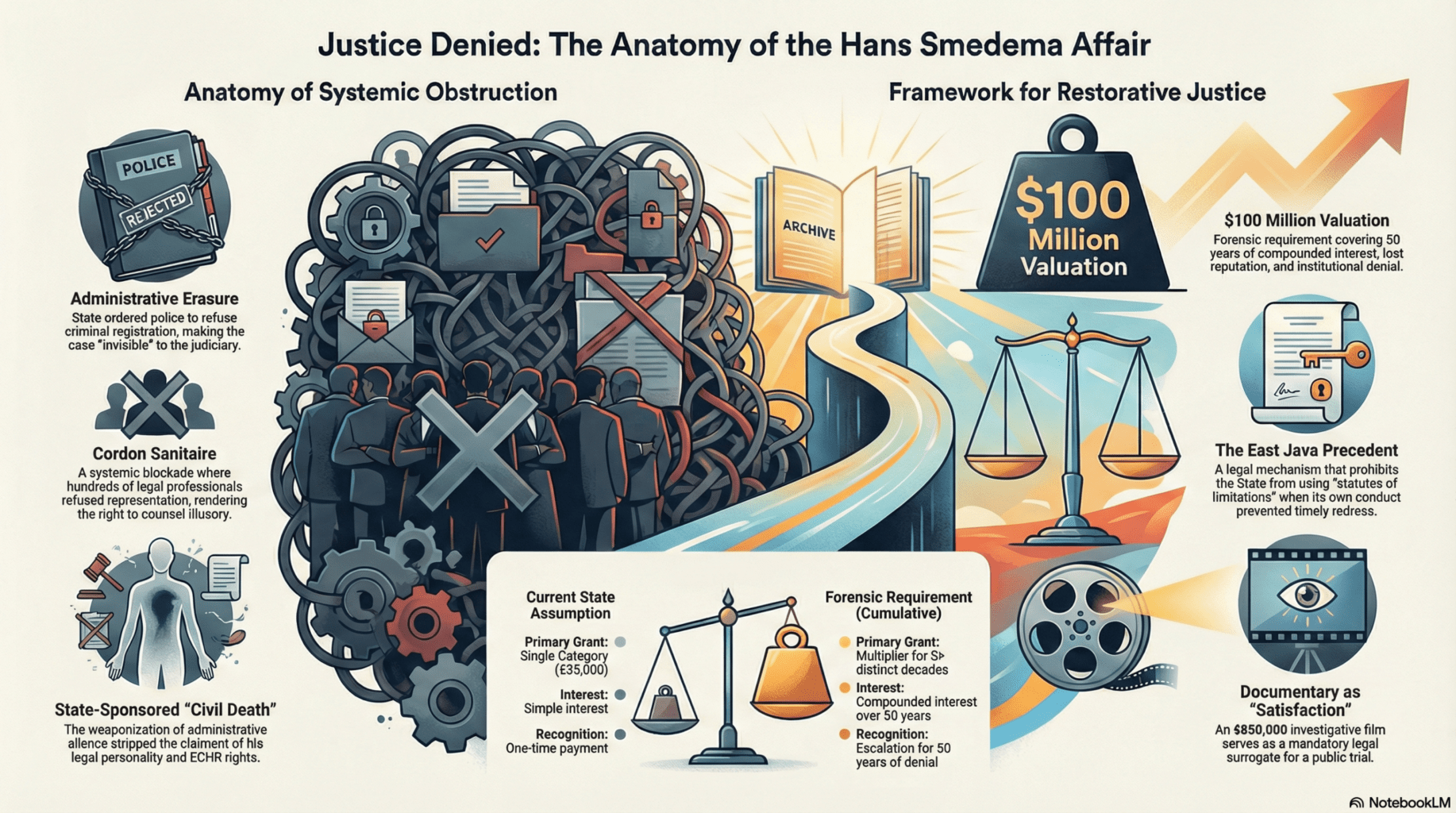
Google NotebookLM Plus Infographic and Report:
1. The Anatomy of Systemic Obstruction: 50 Years of Prevented Justice
The “Smedema Affair” represents a critical failure of the Dutch constitutional order, characterized by a strategic “Catch-22” engineered by the Ministry of Justice and Security (JenV). The State has occupied a dual and untenable role: acting simultaneously as the primary perpetrator of institutional failure and the sole gatekeeper of legal redress. This structural conflict of interest has effectively nullified the claimant’s rights under the European Convention on Human Rights (ECHR) and the Dutch Civil Code (Burgerlijk Wetboek). By controlling the entry points to the judiciary, the State has utilized its administrative weight to ensure that the claimant’s grievances remain legally non-existent.
The Paper Trail of Obstruction, forensic in its consistency, details a calculated suppression of the rule of law:
- Ordered Refusal of Criminal Registration: In April 2004, Detective Haye Bruinsma of the Drachten Police was explicitly ordered by the Ministry of Justice to refuse the filing of a proces-verbaal. This act constitutes a violation of the mandatory duty to receive reports of criminal offenses under Article 163 of the Code of Criminal Procedure and an unlawful act (onrechtmatige daad) under BW Article 6:162.
- The “Cordon Sanitaire”: A systemic blockade where hundreds of legal professionals refused representation, suggesting a “Secret Curatele” or administrative flagging within the Legal Aid Board (Raad voor Rechtsbijstand), rendering the claimant’s right to counsel practically illusory.
- Administrative Erasure: By blocking the proces-verbaal, the State prevented the assignment of a case registration number. This omission—a breach of the State’s positive obligation under BW Article 3:296—ensured the case remained “invisible” to the Public Prosecution Service and the judiciary.
This state of “Civil Death” was achieved through the weaponization of administrative silence. The lack of an initial police registration served as a jurisdictional poison pill, ensuring the failure of all downstream administrative, medical, and financial remedies. Without the foundational document of a proces-verbaal, the claimant was stripped of his legal personality and his right to a fair trial under ECHR Article 6.
2. The Geweldfonds Barrier: Administrative Entrapment and Lost Opportunity
The Schadefonds Geweldsmisdrijven (Violent Offences Compensation Fund) is mandated to provide recognition and redress for victims of violence. In this case, however, the fund was utilized as an instrument of administrative entrapment. The State successfully exploited an “Evidentiary Vacuum” of its own making: the Geweldfonds requires “objective evidence” (police reports or judicial sentences) to validate claims, yet the Ministry of Justice actively blocked the creation of these very documents.
This exclusion is exacerbated by a profound “Clinical Schism” used to facilitate institutional gaslighting. The State’s medical establishment has consistently ignored the “Trauma Model” of Structural Dissociation of the Personality, misdiagnosing the claimant with “Schizophrenia” or “Delusional Disorder” to invalidate his testimony. This misdiagnosis—often labeled as the “Onno van der Hart Paradox”—represents a catastrophic failure of professional standards. Prof. Dr. Onno van der Hart, a pioneer of dissociation theory, serves as a focal point in this systemic failure where the State’s refusal to screen for trauma-based dissociation functions as medical malpractice and a violation of BW Article 6:106 (non-pecuniary loss).
The fund’s Hardship Clause (Hardheidsclausule) failed entirely because the Geweldfonds deferred to the “epistemic arrogance” of the State’s biased psychiatric and prosecutorial narratives. Rather than providing the promised recognition, the fund’s refusal reinforced the claimant’s secondary victimization, effectively immunization the State from liability for its own 50-year campaign of invalidation.
3. Forensic Valuation of Damages: The Multi-Claim Multiplier Effect
A standard “Category 6” grant from the Geweldfonds (€35,000) is legally and forensically insufficient for a case involving a 50-year trajectory of State-sponsored obstruction. Under international human rights standards, the State is liable for the total potential value of all missed claims, including the compounding of interest and the loss of psychological “recognition.”
The following table contextualizes the claim within the broader US$100 million benchmark valuation required for total restorative justice:
| Damage Component | Current State Assumption | Forensic Requirement (Cumulative) |
| Primary Grant(s) | Single Category 6 (€35,000) | Multiplier for 5+ distinct incidents/decades |
| Interest Calculation | Simple interest (standard) | Compounded interest over 50 years of delay |
| Heads of Damage | Direct physical/mental harm | Harm + Reputation + Lost Right to Litigate |
| Recognition Multiplier | One-time payment | Escalation for 50 years of institutional denial |
| Valuation Context | Nominal settlement | Part of a US$100M total restorative package |
The “Lost Right to Litigate” must be recognized as a distinct head of damage. The State’s obstruction did not merely delay justice; it made the exercise of ECHR Article 6 rights “illusory” for five decades. Per BW Article 6:101, the State cannot invoke a lack of causality when its own administrative interference was the primary cause of the claimant’s inability to secure judicial or financial remedies.
4. The Shifting Burden of Redress: When Criminal Prosecution is Obsolete
As the primary perpetrators are now deceased or beyond the age of viable prosecution, the State’s obligation has shifted from punitive justice to comprehensive redress under UNCAT Article 14. Redress is no longer a matter of criminal conviction but of “Satisfaction” and “Guarantees of Non-Repetition.”
Per UNCAT General Comment No. 3, the principle of “Satisfaction” specifically requires the “verification of the facts and full and public disclosure of the truth.” Because the State’s 50-year obstruction has rendered a traditional trial impossible, the proposed €850,000 investigative documentary serves as a mandatory, proportionate legal surrogate for a public trial.
- Legal Justification: The documentary acts as a non-monetary remedy to restore the claimant’s dignity and reputation, which were dismantled by the “delusional” narrative.
- Statute of Limitations: Under the “East Java Precedent”, the State is legally prohibited from invoking the statute of limitations (verjaring). The precedent establishes that when the State’s own conduct—administrative obstruction and failure to investigate—prevents a victim from seeking timely redress, the bar of verjaring must be lifted to satisfy the requirements of “reasonableness and fairness.”
5. Final Synthesis: Total Damages and the Imperative for State Settlement
The total damages claim against the Kingdom of the Netherlands is an essential restorative measure to address the erosion of the claimant’s legal protection. The settlement must encompass both the monetary value of lost Geweldfonds opportunities and the costs of total reputational rehabilitation.
Crucial Points for Calculation:
- The Multiplier Effect: The claim incorporates multiple Category 6 grants, compounded with interest across five decades of unfiled claims, reflecting a total failure of domestic remedies.
- Documentary as Reparation: The €850,000 budget is a legitimate head of damage, functioning as a necessary instrument of “Satisfaction” to achieve the “public disclosure of the truth” mandated by UNCAT.
- The East Java Precedent: This legal mechanism specifically overrides any defense of verjaring, as the State’s refusal to register the 2004 proces-verbaal directly prevented the claimant from adhering to standard filing timelines.
- Institutional Malpractice: The forensic requirement includes damages for “Psychiatric Hegemony,” where the misdiagnosis of dissociation as schizophrenia (ignoring the Trauma Model) constituted a deliberate breach of the duty of care.
The Dutch State has a positive obligation under the ECHR to restore the claimant’s dignity. Failure to settle this matter immediately risks the perpetuation of “Systemic Blindness,” wherein the bureaucracy remains shielded by its own pathologies. This case is no longer merely a private dispute; it is a constitutional imperative to restore the integrity of the rule of law in the Netherlands.
——————————————————————————–
End of Legal Analysis