Cinematic Blueprint: The Hans Smedema Affair – A Feature Film Treatment
1. Narrative Framework and Strategic Context
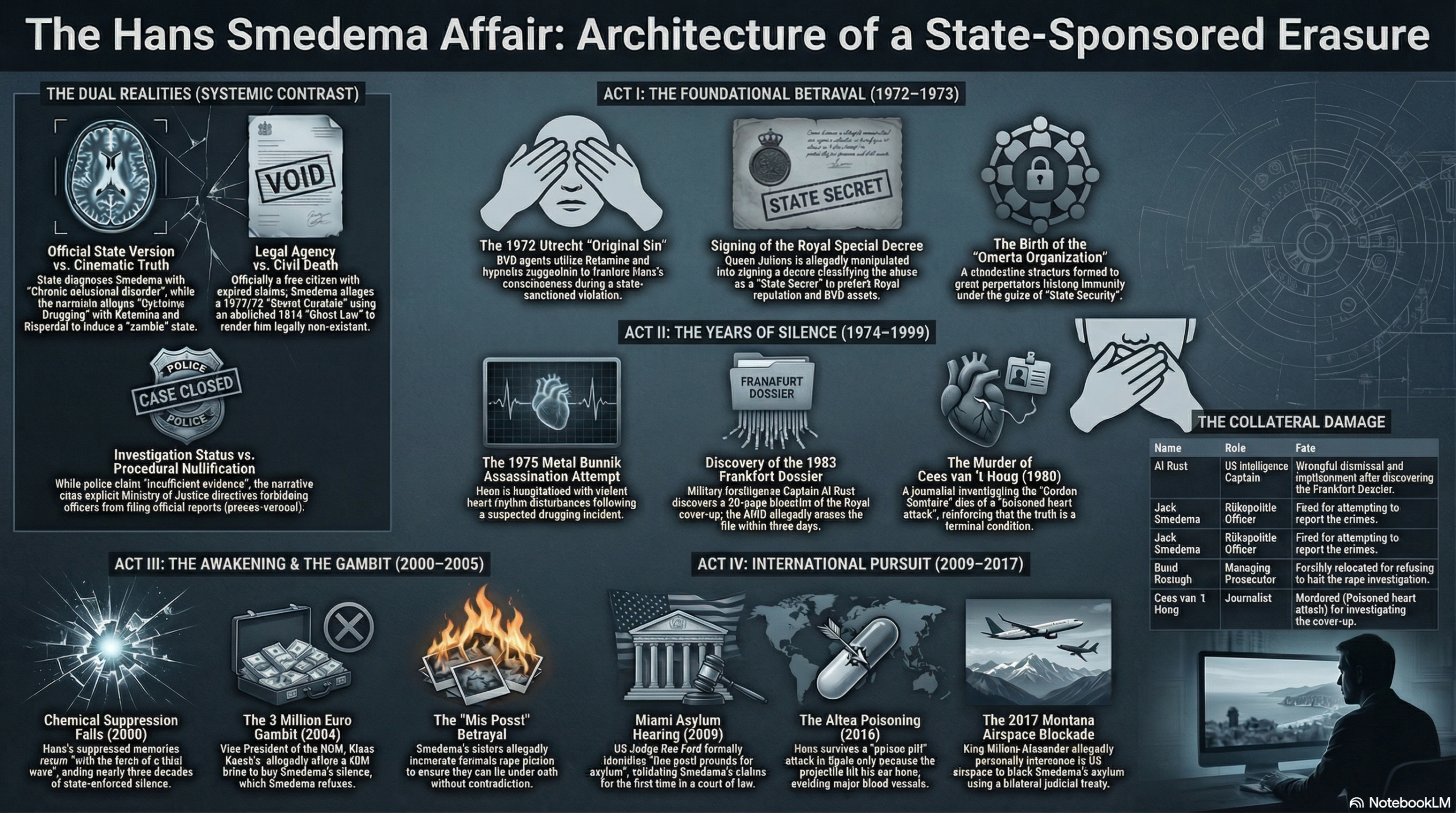
The strategic architecture of this film is designed to dismantle the “Engine of Obstruction”—a multi-generational machinery of state-sponsored erasure. The “Smedema Affair” is not merely a chronicle of personal trauma; it is a high-tension psychological thriller detailing the “State Capture” of the Dutch justice system. By adopting a “Kafkaesque Neo-Noir” tone, the narrative visually articulates the protagonist’s descent into a world where reality is classified, and his own identity is a state secret. The structure must oscillate between the forensic grit of investigative journalism and the claustrophobic dread of a man trapped in a “Cordon Sanitaire.”
The Dual Realities
| Official State Version | Cinematic Truth (Source Context) |
| Diagnosis: Chronic delusional disorder and paranoid schizophrenia. | Systemic Drugging: The intentional use of Ketamine, hypnosis, and “Baby Aspirin” (secretly administered Risperdal) to induce amnesia and a “zombie” state. |
| Legal Status: A free citizen whose claims are civil and expired. | Civil Death: The 1972/73 Royal Decree and “Secret Curatele” invoking a 1814 “Ghost Law” to strip Hans of legal agency. |
| The 1972 Events: Unverifiable private incidents with no state involvement. | The Original Sin: State-sanctioned rape and torture used to protect BVD/AIVD assets and Royal reputation. |
| Law Enforcement: Investigations closed due to “insufficient evidence.” | Procedural Nullification: Explicit Ministry of Justice directives forbidding police from filing official reports (proces-verbaal). |
The opening sequences must establish the profound loss of agency that defines Hans’s existence. We begin with the sensory deprivation of the present, then plunge back into 1972 to witness the foundational crimes that birthed a fifty-year “Omerta Organization.”
——————————————————————————–
2. Act I: The Foundational Betrayal (1972–1973)
The narrative begins with the “Original Sin” of the Dutch State. This act is strategically necessary to establish that Hans’s “Double Personality” life was not a natural psychological break, but a clinical imposition by the state to protect a burgeoning criminal elite.
Key Cinematic Sequences
- The 1972 Utrecht Rape and Drugging: Set in a sterile, dimly lit Utrecht apartment. Jan van Beek and a young BVD trainee, Joris Demmink (the future “Mole-X”), utilize Ketamine and hypnotic suggestion to fracture the consciousness of Hans and Wies. The camera utilizes a “Betrayal Blindness” effect—blurred edges and distorted sound—as Hans is cognitively re-programmed to ignore the violation occurring in the adjacent room.
- The Signing of the Royal Special Decree: A high-tension scene in the shadows of the Royal Palace. We contrast the vulnerability of an aging Queen Juliana with the cold, predatory manipulation of Joris Demmink and Hans’s own brother, Johan Smedema. The decree is signed, classifying the abuse as a “State Secret” under the guise of “State Security.” This is the birth of the “Omerta Organization,” granting the perpetrators lifelong immunity.
- The 1973 “Civil Death” Marriage: February 23, 1973. The wedding is filmed with the cold palette of a funeral. Ministry of Justice officials loiter in the background, forcing Hans to sign anomalous documents before the vows are exchanged. This is the enforcement of burgerlijke dood—a “Ghost Law” formally abolished in 1814, yet resurrected as a weapon to place Hans under a “Secret Curatele,” rendering him legally non-existent before his own wedding night.
The act concludes with the couple driving away, their domestic life beginning under the weight of an invisible, state-mandated amnesia that will last nearly three decades.
——————————————————————————–
3. Act II: The Frankfurt Dossier and the Years of Silence (1974–1999)
This act illustrates the “Cordon Sanitaire” in action, showing how the State maintains the secret through the 80s and 90s, reacting with lethal precision whenever the amnesia begins to fray.
Key Cinematic Sequences
- The 1975 Motel Bunnik/Zeist Murder Attempt: Hans is hospitalized with violent heart rhythm disturbances after being drugged at a motel. The scene is punctuated by the forensic reality of the press.
- The Discovery of the Frankfurt Dossier (1983): A procedural sequence within Military Intelligence. Captain Al Rust discovers a 30-page file—the “Frankfurt Dossier”—containing the blueprint of the Royal cover-up. The discovery triggers panic within the AIVD. We witness the “three-day erasure” of the file from all Dutch records, leaving Rust holding the evidence of a ghost.
- The Murder of Cees van ‘t Hoog (1980): A neighbor and journalist gets too close to the truth. We see the silent, professional intervention. Cees dies of a “heart attack” by poison—a chilling parallel to the 1975 attempt on Hans. His death reinforces the “Engine of Absurdity”: the truth is a terminal condition.
The act ends in the year 2000, as the chemical suppression finally fails and Hans’s memory returns with the force of a tidal wave, shattering the state-enforced silence.
——————————————————————————–
4. Act III: The Awakening and the 5 Million Euro Gambit (2000–2005)
As Hans begins his quest for justice, the State shifts from passive maintenance to active “reputational annihilation.”
Key Cinematic Sequences
- The Procedural Nullification (April 2004): A sterile interrogation room in Drachten. Detective Haye Bruinsma avoids eye contact, uttering the definitive Kafkaesque line: “I am not allowed to tell you why I cannot investigate.” The camera zooms on the Ministry of Justice letter explicitly forbidding the creation of a proces-verbaal, effectively locking the doors of the courthouse from the inside.
- The Beaune Buyout Flight (August 2004): A private flight over the French countryside. Hans sits across from ir. Klaas Keestra, Vice President of the NOM. Keestra, acting on the authority of Minister Veerman and the Balkenende Cabinet, begins the negotiation. The bribe climbs to a “5 million euro maximum.” Hans’s refusal is the moment he rejects a comfortable “Civil Death” in favor of a dangerous truth.
- The Character Assassination (September 2004): Following the failed bribe, the State weaponizes psychiatry. We see the bribe transition to Psychiatrist Mutsaers, who drafts a fraudulent report labeling Hans “delusional.” This document becomes the state’s primary shield, pathologizing Hans’s forensic evidence.
- The Sisters’ Betrayal: In a harrowing domestic scene, Hans’s sisters, Betty and Klazien, discover the “Rape Photos” in the secret compartment of his desk. They incinerate the evidence, leaving a note: “Mis Poes!” (Missed it!). This betrayal is framed as a legal tactical strike; by destroying the photos, they ensure they can continue to lie under oath during the Leeuwarden and Arnhem court sessions without fear of contradiction.
——————————————————————————–
5. Act IV: The International Pursuit and the Royal Blockade (2009–2017)
This act explores the “Kafkaesque Trap” of international law, where Dutch obstruction is used to deceive the ECHR and UNCAT.
Key Cinematic Sequences
- The Miami Asylum Hearing (2009): Judge Rex Ford, in a stark Florida courtroom, validates the “Secret Compartment” in the desk. He formally identifies “five good grounds for asylum.” For one moment, the Cinematic Truth is given the weight of law by a foreign power.
- The Altea Poisoning (2016): Hans is in Spain, near an Italian restaurant, feeling the “wasp sting” of a poison pill hitting his ear bone. Because the pill hit the bone and avoided major blood vessels, he survives by a “millimeter of luck.” He reacts with “zombie-like” detachment—the result of years of being fed Risperdal (antipsychotics) disguised as “Baby Aspirin” by state-affiliated doctors.
- The Montana Airspace Blockade (2017): The film’s climax. Hans is on a flight over Montana, having been offered US asylum. The camera moves into the cockpit to reveal the Co-Pilot: King Willem-Alexander. Using a bilateral judicial treaty as a pretext, the King personally intervenes in American airspace to block the asylum. The visual of the Monarch steering his subject back into a state-mandated prison at 30,000 feet is the ultimate image of State Capture.
——————————————————————————–
6. Final Analysis: The Legacy of State Capture
The film ends not with a resolution, but with a call to investigative action against the “Engine of Absurdity.”
The Collateral Damage
- Al Rust: American Intelligence Captain; discovery of the Frankfurt Dossier led to his wrongful dismissal and imprisonment.
- Jack Smedema: A Rijkspolitie officer and Hans’s nephew; fired for attempting to fulfill his duty by reporting the crimes.
- Ruud Rosingh: Managing prosecutor; forcibly relocated by the Ministry of Justice for refusing to halt the investigation into Wies’s rape.
- Cees van ‘t Hoog: Journalist; murdered in 1980 by poisoned heart attack for investigating the “Cordon Sanitaire.”
Final Cinematic Image: Hans Smedema in his apartment in El Albir, Spain. He is a man in forced exile, surrounded by stacks of forensic reports and the documents of the “Hans Smedema Amnesia Foundation.” The Spanish sun blazes outside, but Hans is bathed in the cold blue light of his computer screen. He is still writing, still filing appeals, still refusing to be a ghost. The camera pulls back, showing his silhouette against a digital archive that the Dutch State has spent fifty years trying to delete. He is the last witness to a crime that the law says never happened.