Last Updated 19/01/2026 published 05/01/2026 by Hans Smedema
Page Content
An Analysis of U.S. Actions in the Hans Smedema Affair: A Trajectory of Validation and Contradiction
‘Life is not measured by the moments we breathe, but by the moments that take our Breath away!’
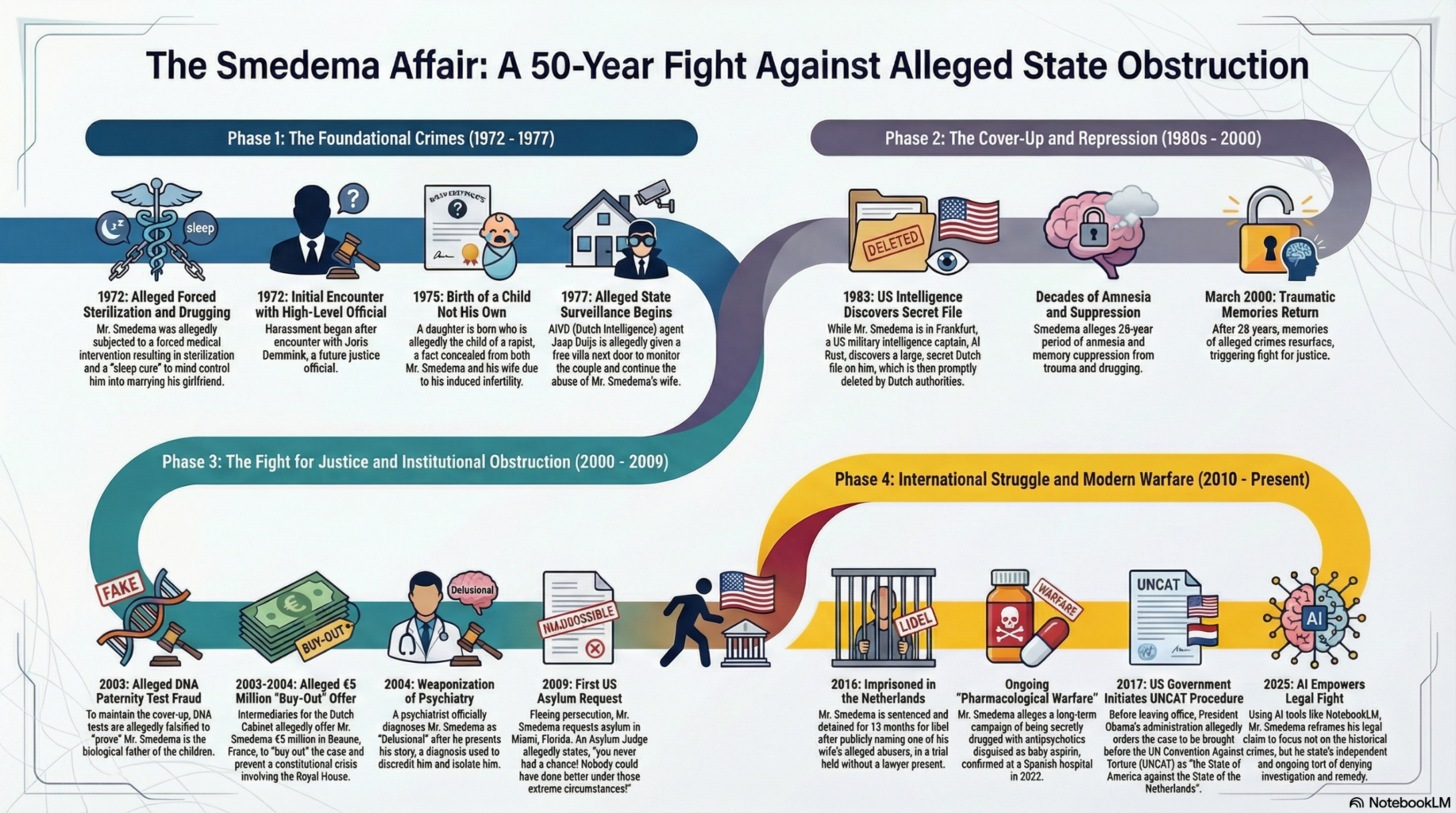
Google NotebookLM Plus Report based on 269 sources:
1. Introduction: The Central Paradox of U.S. Involvement
The engagement of the United States in the Hans Smedema affair is characterized by a profound contradiction. On one hand, multiple U.S. state and judicial bodies are alleged to have validated the severity and credibility of his claims against the Kingdom of the Netherlands, taking actions unprecedented in their scope. On the other hand, the ultimate outcome was his deportation into the custody of the very state he accused, followed by an apparent lack of public, decisive action from the U.S. government. This document will analyze the timeline of U.S. actions to identify the potential missteps and explain the strategic context that may have led to the case being handled with a high degree of secrecy. This approach stands in stark contrast to Mr. Smedema’s own strategy of “extreme openness,” an attempt to generate public accountability where official channels seemed to fail. This analysis begins by examining the initial U.S. validation of Mr. Smedema’s case, which established a powerful, yet ultimately unfulfilled, foundation of credibility.
2. A Foundation of Credibility: Documented Validation by U.S. Institutions
The strategic importance of the initial validation Mr. Smedema’s case received from U.S. institutions cannot be overstated. These actions, spanning the judicial, investigative, and executive branches of the U.S. government, established a baseline of credibility for his allegations against the Netherlands. This official acknowledgment makes the final outcome of his deportation all the more perplexing and suggests a complex interplay of legal, diplomatic, and intelligence factors that superseded the initial findings.
2.1. Judicial Validation: The Findings of U.S. Immigration Judge Rex J. Ford
The earliest and most significant judicial validation of Mr. Smedema’s claims came from U.S. Immigration Judge Rex J. Ford. His alleged findings and actions established a formal, legal basis for treating the allegations with the utmost seriousness.
- Initial Asylum Grounds (2009): In a finding described as both “unbelievable” and “unique” in American history, Judge Ford reportedly established “5 good grounds for asylum” for Mr. Smedema against the Netherlands.
- Case Reopening (2014): Judge Ford is credited with reopening the case in 2014, signaling continued judicial interest and belief in the potential merit of the asylum claim.
- Extraordinary Intervention (2017): In a highly unusual move, Judge Ford is alleged to have attempted to facilitate an asylum offer for Mr. Smedema while his deportation flight was in U.S. airspace over Montana on March 15, 2017.
2.2. Investigative and Financial Validation: The Role of the FBI, CIA, and DOJ
Parallel to the judicial process, U.S. intelligence and justice agencies reportedly conducted their own inquiries, which allegedly corroborated key aspects of the case and assigned a significant financial value to the claim.
- Intelligence Corroboration: The Federal Bureau of Investigation (FBI) and the Central Intelligence Agency (CIA) are said to have conducted “extensive investigations” that not only validated aspects of Mr. Smedema’s claims but also reportedly uncovered evidence of Dutch obstruction on U.S. soil.
- Financial Valuation: Based on these investigations, the U.S. Department of Justice (DOJ) allegedly estimated the potential value of the claim for a settlement against the Netherlands at a staggering US$50 million.
2.3. Executive-Level Validation: The Alleged Obama-Initiated UNCAT Complaint
The single most significant allegation of U.S. executive action is the reported intervention by President Barack Obama. In January 2017, just before leaving office, President Obama is alleged to have initiated an official complaint by the United States against the State of the Netherlands before the UN Committee Against Torture (UNCAT). This action was reportedly based directly on the findings of the FBI and CIA investigations. This alleged move from the highest level of the U.S. government signaled a potential escalation from an individual asylum case to a state-on-state dispute over human rights obligations. However, this executive-level validation would prove insufficient against the direct, on-the-ground obstruction allegedly orchestrated by the Dutch state.
3. The Counter-Narrative: Alleged Dutch Obstruction on U.S. Soil
U.S. actions in the Smedema affair did not occur in a vacuum. According to the available documentation, the Dutch state actively worked to influence the outcome of Mr. Smedema’s asylum attempts. These alleged interventions created a direct diplomatic and legal conflict for U.S. authorities, forcing them to navigate between their own internal findings and the actions of a key international ally.
3.1. Misuse of International Agreements
The allegation that the Netherlands weaponized a bilateral judicial treaty transforms a tool of cooperation into an instrument of obstruction. The Netherlands is accused of misusing the agreement for the specific purpose of preventing Mr. Smedema from gaining asylum. For U.S. authorities, this creates a profound legal dilemma: honoring the letter of a treaty obligation versus upholding the spirit of justice validated by their own internal investigations.
3.2. A Foreign Head of State’s Alleged Intervention
In one of the most extraordinary claims of the entire affair, King Willem-Alexander of the Netherlands is alleged to have personally intervened to thwart the asylum process. According to the sources, on March 15, 2017, the King was acting in his capacity as a KLM co-pilot on the flight deporting Mr. Smedema. While in U.S. airspace, he allegedly intercepted the asylum offer being communicated by Judge Rex J. Ford. It is claimed that the King and an accompanying Dutch intelligence agent lied to U.S. authorities, falsely stating that Mr. Smedema did not want asylum. This alleged direct intervention by a foreign head of state to block a U.S. judicial process on American soil represents a profound diplomatic breach, forcing U.S. authorities into a direct conflict between upholding their judicial findings and confronting a major NATO ally.
4. Analysis of U.S. Missteps: From Apparent Support to Deportation
The “mistakes” in the U.S. handling of this affair were not procedural errors but a fundamental failure to act upon the powerful validation generated by its own institutions. This disconnect suggests a deliberate policy choice where diplomatic considerations ultimately superseded the substantiated claims of an individual its own systems had deemed credible.
4.1. The Failure to Protect
The chasm between the U.S. government’s alleged findings and its ultimate actions is stark. The validation provided a clear basis for protection, yet the final outcome was the opposite.
| Validating Actions | Contradictory Outcomes |
| Judicial Finding: Judge Ford finds “5 good grounds for asylum,” a “unique” event. | Blocked Asylum: Multiple asylum attempts are ultimately blocked, allegedly due to Dutch interference. |
| Intelligence Validation: FBI/CIA investigations reportedly validate claims and uncover Dutch obstruction. | Deportation: Mr. Smedema is deported to the Netherlands on March 15, 2017, despite an alleged last-minute asylum offer. |
| Financial Valuation: The DOJ values the potential settlement at US$50 million. | Subsequent Detention: Mr. Smedema is arrested upon arrival and subsequently held in detention for 14 months. |
| Executive Action: President Obama allegedly initiates a UNCAT complaint against the Netherlands. |
4.2. The Question of Secrecy
The U.S. response was likely paralyzed by a triad of conflicting imperatives: the diplomatic necessity of preserving its alliance with the Netherlands, the legal constraints imposed by the alleged weaponization of a bilateral treaty, and the institutional imperative to keep intelligence findings from the FBI and CIA classified. This created a situation where public action was diplomatically untenable, while inaction contradicted the U.S.’s own internal findings.
4.3. A Tale of Two Strategies: U.S. Secrecy vs. Smedema’s Openness
The affair reveals a fundamental clash between the U.S. government’s conventional reliance on confidential channels and Mr. Smedema’s asymmetric strategy of “weaponisation of my extreme openness.” Lacking institutional power and allegedly denied access to legal recourse, his approach has been to publish his extensive documentation and allegations publicly. This represents a clear attempt to create public accountability where official, secret channels had evidently failed to produce a resolution or protect his rights. This strategic divergence ultimately explains why the U.S. government’s internal validation never translated into the public resolution Mr. Smedema sought to force.
5. Conclusion: A Case of Unreconciled Findings
The primary misstep in the U.S. handling of the Hans Smedema affair was not a failure to investigate, but an apparent failure to act decisively upon its own alleged findings. The timeline of events points to a robust and multi-faceted validation process across the U.S. government—from the judiciary to the intelligence community and even the executive office—that deemed Mr. Smedema’s claims credible and serious. However, this powerful initial engagement ultimately appears to have been subordinated to the pressures of diplomatic protocol, the constraints of international treaty obligations, and the alleged direct intervention of the Dutch state. The U.S. engagement, while providing powerful validation for the case, ultimately resulted in the deportation of Mr. Smedema, leaving the critical questions raised by its own justice and intelligence agencies unanswered in the public domain.